







Owning an above ground pool is a rewarding investment, with an estimated 4.3 million units installed across the United States.
These pools offer a budget-friendly way to enjoy backyard swimming, but they require regular care to keep the water clean, safe, and inviting.
Unlike in-ground pools, above ground models have smaller water volumes, vinyl liners, and smaller filters—meaning chemical balances shift faster and debris accumulates more quickly.
A consistent maintenance routine prevents cloudy water, algae growth, and costly repairs.
This guide covers daily, weekly, and seasonal tasks to help you protect your pool and extend its lifespan.
Daily Maintenance Tasks
Spending just five to ten minutes each day on basic upkeep prevents minor issues from escalating. Start by testing the water chemistry.
Using a reliable test kit or test strips, check the pH and free chlorine levels.
The ideal pH range is 7.4 to 7.6, while chlorine should stay between 1.0 and 3.0 parts per million (ppm).
Daily testing is especially important in above ground pools because the smaller volume means chemical levels can shift quickly after heavy use or rainfall.
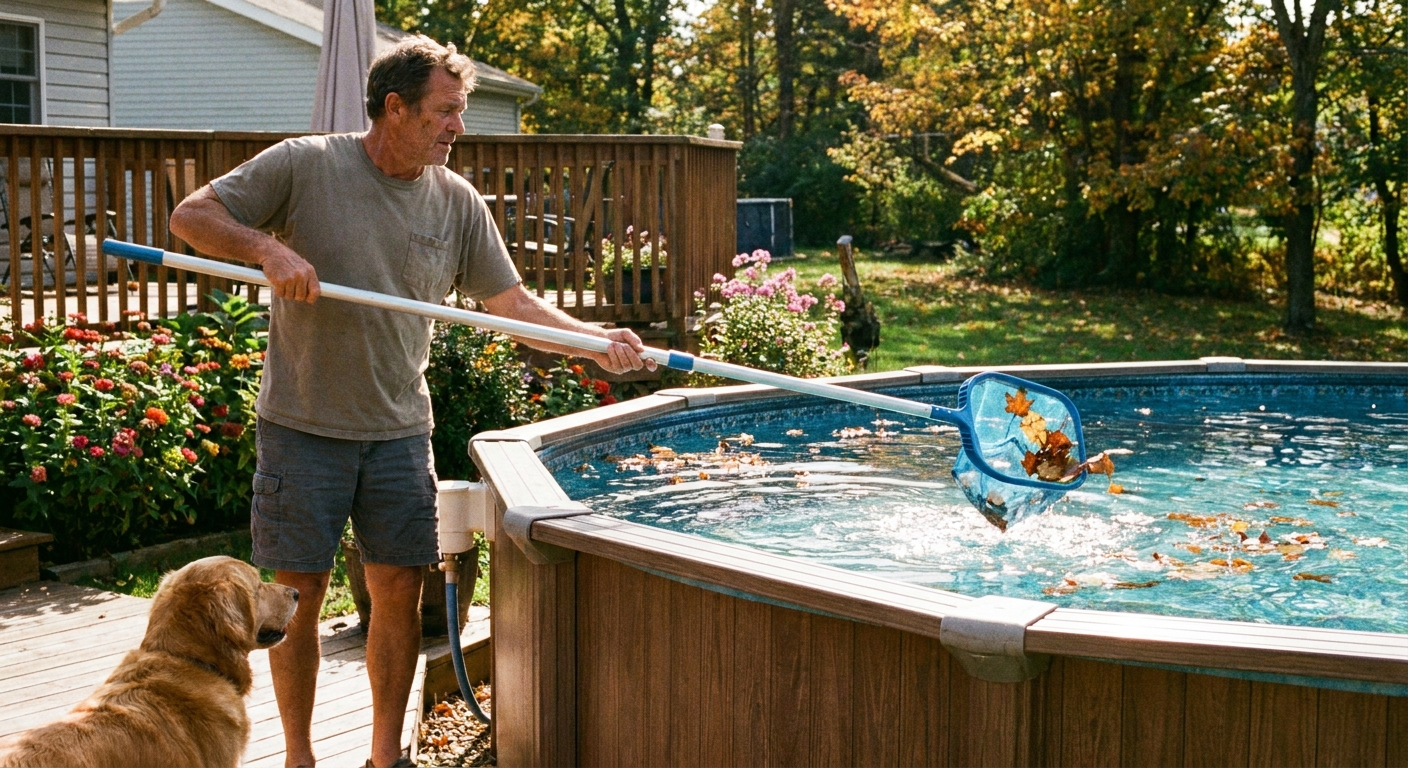
Next, skim the water surface with a flat leaf skimmer.
Leaves, bugs, and pollen sink rapidly in above ground pools and can stain the vinyl liner if left in place.
Removing debris daily also reduces chlorine demand, as decaying organic matter consumes sanitizer. While skimming, empty the skimmer basket and pump basket.
A clogged basket can reduce water flow by 30 to 50 percent, forcing the pump to work harder and reducing filtration efficiency.
Turn off the pump before emptying the basket to avoid air locks.
Finally, run the pump and filter system for at least eight hours each day.
Circulation prevents stagnant water, which is a breeding ground for bacteria and algae.
A timer can automate this process, ensuring consistent operation even on busy days.
During the hottest parts of the day, running the pump helps distribute chlorine more effectively.
Weekly Maintenance Tasks
Once a week, dedicate 30 to 45 minutes to deeper cleaning. Begin by vacuuming the pool floor.
Above ground pools typically lack a main drain, so dirt and debris settle on the bottom.
Use a manual vacuum head attached to a telescopic pole, or an automatic pool cleaner designed for above ground models.
Move slowly in overlapping passes to capture debris without stirring it up.
Brushing the walls and floor is equally important.
Even if the water looks clear, algae spores can colonize areas with poor circulation.
Use a soft nylon brush—never a wire brush, which can tear the vinyl liner.
Pay extra attention to crevices, behind ladders, and near steps.
Brush in a downward motion to push debris toward the floor for vacuuming.
Clean the filter according to its type.
For cartridge filters, turn off the pump, remove the cartridge, and rinse it with a garden hose.
If the pressure gauge reads 8 to 10 psi above the clean baseline, it is time to clean.
Soak the cartridge in a filter cleaner solution monthly and replace it annually.
For sand filters, perform a backwash cycle when the pressure rises: set the valve to backwash, run until the sight glass clears, then rinse and return to filter mode. Sand should be replaced every three to five years.
Shock the pool every one to two weeks, or after heavy rain or parties.
Use a calcium hypochlorite or non-chlorine shock, added in the evening to prevent sunlight from degrading the sanitizer. Run the pump for at least eight hours afterward.
Shock treatments eliminate contaminants that regular chlorine levels cannot handle, keeping the water safe for swimmers.
Seasonal Care: Winterizing and Spring Opening
Above ground pools are seasonal in many climates, requiring careful preparation for winter and a thorough reopening in spring. Winterizing protects the pool from freeze damage.
Start by balancing the water chemistry to recommended levels, then shock the pool heavily.
Lower the water level to four to six inches below the skimmer to prevent ice expansion from cracking fittings. Drain all equipment—pump, filter, heater—and store them indoors.
Install a winter cover tightly secured with water tubes or cables to keep out debris and animals.
In early spring, once ice has fully thawed, remove the cover and inspect the liner for tears or leaks.
Clean the walls and floor thoroughly, then reinstall equipment and refill the pool slowly.
Test and rebalance the water chemistry, then run the pump continuously for 24 to 48 hours.
Shock the pool with a double dose to kill any algae that survived the winter.
Proper seasonal transitions are essential to avoid equipment failure and delayed swim season.
For ongoing care throughout the swimming season, regular attention to water chemistry, cleaning, and filter maintenance keeps the pool running smoothly.
A structured schedule—daily skimming and testing, weekly vacuuming and brushing, and monthly deep cleaning—ensures that every aspect of above ground pool maintenance is covered.
Common Problems and Quick Solutions
Even with diligent care, issues can arise.
Cloudy water often results from insufficient sanitizer, poor filtration, or pH imbalances.
Shock the pool and adjust chemical levels, then run the filter continuously until clarity returns.
Algae growth appears as green, yellow, or black spots on the liner.
Treat with an algaecide and brush the affected areas, then shock the water.
Leaks and tears in the vinyl liner should be patched immediately with a vinyl repair kit for holes under three inches; larger tears require liner replacement.
Equipment failure, such as a pump losing prime or a filter leaking, is best diagnosed by a professional.
Keep spare O-rings and filter cartridges on hand for quick swaps.
By following a consistent maintenance routine and addressing small problems early, you can enjoy clear, safe water throughout the summer. Above ground pools are a wonderful backyard feature, and with proper care they provide years of family fun without unexpected downtime.