







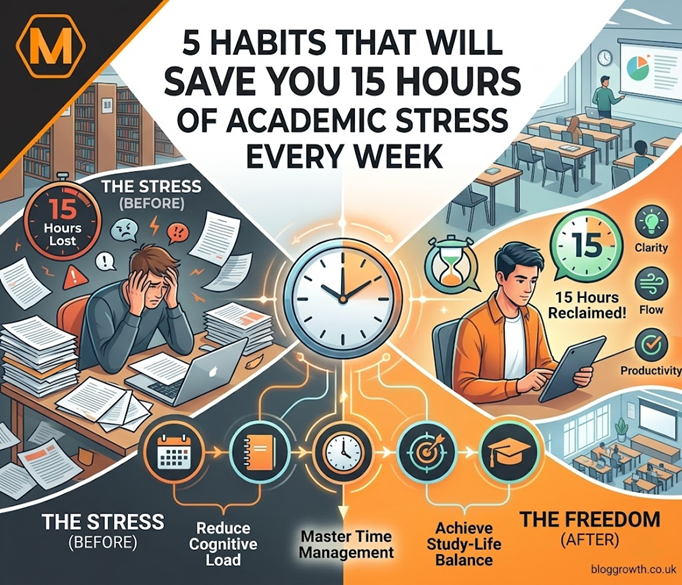
The transition from a structured high-school environment to the self-governed world of university is often a shock to the system. For many students, the “freedom” of college quickly transforms into a crushing weight of looming deadlines and complex research requirements. We often treat academic stress as an unavoidable rite of passage, a badge of honor worn by the chronically sleep-deprived. However, the difference between a student who thrives and one who barely survives isn’t usually intelligence—it is the architecture of their daily habits. By shifting your approach from reactive “firefighting” to proactive systems, it is entirely possible to reclaim over 15 hours of your week.
The first step in reducing cognitive load is recognizing when your internal bandwidth has reached its limit. When the sheer volume of tasks leads to total “deadline paralysis,” the most productive habit you can adopt is knowing how and when to delegate. Instead of staring at a blank screen for five hours, you can choose to reach out to experts and say do my assignment at myassignmenthelp to bridge the gap between your current knowledge and the required academic standards. This isn’t just about getting a task done; it is about strategic time management. By outsourcing the most labor-intensive research phases, you free up nearly an entire workday’s worth of time to focus on high-priority subjects or necessary self-care. This strategic delegation allows you to maintain a high GPA without sacrificing your mental well-being or physical health.
The “Second Brain” and Digital Minimalism
We spend an average of 30% of our study time just looking for information we’ve already seen. Whether it is a half-remembered quote from a lecture or a PDF buried in a “Downloads” folder, this digital friction causes massive academic stress. The habit of Digital Minimalism involves creating a “Second Brain”—a single, searchable database where every piece of research is tagged and stored instantly. Tools like Notion, Obsidian, or even a well-organized Google Drive serve as an external hard drive for your mind.
By spending ten minutes at the end of each day filing your notes and clearing your desktop, you eliminate the “search fatigue” that usually precedes a study session. When you sit down to work, you aren’t fighting your computer; you are immediately entering a state of flow. This single shift in organization can easily save you four hours a week that would otherwise be wasted on digital clutter. Imagine the mental clarity of opening a laptop and seeing exactly what you need for your dissertation, rather than a sea of untitled documents.
Implementation of “Micro-Productivity” Sprints
The traditional idea of a four-hour study block is largely a myth. Human focus typically wanes after 40 to 50 minutes, leading to “diminishing returns” where you are reading words without absorbing their meaning. Time saving habits like micro-productivity involve breaking your day into 25-minute “Pomodoro” bursts followed by five-minute active breaks. This method leverages the brain’s natural rhythm and prevents the “overheating” that leads to burnout.
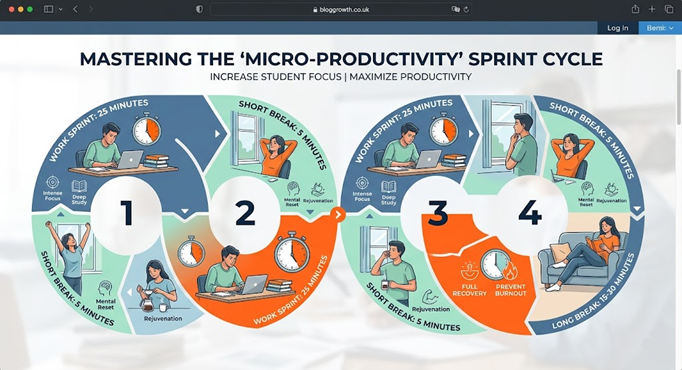
During these sprints, the goal isn’t to finish the whole project, but to master one specific sub-topic. This prevents the brain from feeling overwhelmed by the “bigness” of a dissertation or a 3,000-word essay. By working with your biology rather than against it, you complete tasks in half the time it takes to do them while distracted by social media or fatigue. When you know a break is coming in twenty minutes, you are far less likely to succumb to the “infinite scroll” of TikTok or Instagram.
The “Sunday Reset” for Weekly Forecasting
Most academic anxiety stems from the unknown. If you start your Monday morning wondering what is due, you have already lost the week. The “Sunday Reset” is a 20-minute habit where you audit your upcoming syllabi, extracurriculars, and social commitments. You aren’t just making a to-do list; you are forecasting your energy levels. This allows you to identify “collision points” where multiple deadlines land on the same day.
If you see a week where three midterms overlap, you can plan your study-life balance in advance rather than panicking on Wednesday night. Understanding the historical context of your struggles can also provide a weird sense of relief. For instance, if you’ve ever wondered who invented exams, you can look back to Henry Fischel in the late 19th century, who designed them to test a student’s ability to synthesize information under pressure. Knowing that the system was built for a specific type of assessment helps you realize that a “test” is just a game with specific rules, rather than a reflection of your worth.
Harnessing the Yerkes-Dodson Law
There is a scientific sweet spot for stress. According to the Yerkes-Dodson Law, performance increases with physiological or mental arousal, but only up to a point. When stress becomes too high, performance plummets into a state of anxiety and exhaustion. The habit of “Stress Calibration” involves checking in with your physical symptoms. Are your shoulders at your ears? Is your breathing shallow? Is your heart racing before you even open your textbook?
To save time, you must lower your stress levels back to the “Optimal Arousal” zone. This might mean a ten-minute walk, a breathing exercise, or even a quick power nap. It sounds counterintuitive to stop working to save time, but a calm brain processes information 50% faster than a panicked one. Avoiding student burnout is the ultimate time-saving strategy because it prevents the “total crash” that can sideline a student for weeks. When you operate in the green zone of the curve, your efficiency doubles.
Active Recall vs. Passive Review
The most common “time-waster” in academia is passive reviewing—highlighting textbooks or re-reading notes. It feels like work, but it doesn’t move the needle on long-term retention. The habit of Active Recall involves testing yourself before you feel ready. This creates “desirable difficulty,” which forces the brain to build stronger neural connections.
Close the book and summarize the concept out loud. Draw a mind map from memory. By forcing your brain to retrieve information, you strengthen the neural pathways. Research shows that one hour of active recall is more effective than five hours of passive reading. By switching to this method, you can cut your total revision time by a staggering 60%, leaving you with more free time than you’ve had since the semester began. This is the difference between “studying hard” and “studying smart.”
The 15-Hour Time-Saving Breakdown
To see how these habits actually manifest in a real-world student schedule, look at the potential time reclaimed below:
| Habit Category | Weekly Time Saved | Primary Benefit | Daily Impact |
| Strategic Outsourcing | 6 – 8 Hours | Eliminates research fatigue on secondary subjects. | Reclaims your entire Tuesday evening. |
| Digital Minimalism | 3 Hours | Removes “search friction” and digital clutter. | Saves 25 minutes of “hunting” per day. |
| Active Recall | 4 Hours | Increases retention efficiency significantly. | Cuts study sessions from 3 hours to 1.5. |
| Sunday Reset | 2 Hours | Prevents “panic-mode” and task switching. | Reduces morning “startup” anxiety. |
| Total Reclaimed | 15+ Hours | Equivalent to two full workdays of freedom. | A balanced, stress-free life. |
The Psychological Cost of Procrastination
Beyond the literal hours saved, these habits address the “mental tax” of procrastination. When you have an unfinished assignment hanging over your head, you are never truly resting. Even when you are out with friends or watching a movie, a part of your brain is calculating the remaining time and the mounting pressure. This “background noise” of stress is what leads to chronic fatigue.
By implementing the do my assignment strategy through myassignmenthelp, you effectively “buy back” your mental peace. You transition from a state of “Academic Poverty”—where you are always behind and borrowing time from sleep—to “Brain Wealth,” where you have a surplus of time to explore personal interests, network for your future career, and actually enjoy the social aspects of university life.
Conclusion: Moving Toward a “Brain Wealth” Model
The goal of university isn’t just to graduate; it is to develop a specialized way of thinking. However, you cannot think deeply if you are constantly in survival mode. Reclaiming your time through these five habits allows you to move into a state of “Optimal Arousal” where true learning occurs.
By integrating professional support, mastering your digital environment, and respecting your brain’s natural rhythms, you transform the university experience from a gauntlet of stress into a platform for growth. Start with just one habit this week—perhaps the Sunday Reset—and watch as the chaos begins to subside. The 15 hours are waiting for you to take them back; the only question is what you will do with your newfound freedom.
Frequently Asked Questions
What is the most effective way to reduce study time without lowering grades?
The most efficient method is switching from passive reading to active recall. By testing yourself on the material rather than just re-reading notes, you strengthen memory retention, which can cut total revision time by more than half.
How can I stop feeling overwhelmed by large projects?
Break your workload into “micro-productivity” sprints. Focus on completing one small sub-topic during a 25-minute block of deep work. This prevents the brain from being intimidated by the total scale of the task and keeps momentum high.
Why is digital organization considered a time-saving habit?
Digital friction—searching for lost files or disorganized research—wastes hours every week. Establishing a centralized, searchable database for your notes ensures that you can begin working immediately without the mental fatigue of hunting for information.
How does a weekly forecast help with academic stress?
A weekly audit allows you to identify upcoming deadline clusters before they happen. By seeing these “collision points” in advance, you can adjust your pace early in the week, preventing the last-minute panic that usually leads to burnout.
About The Author
Oliver Smith is a dedicated academic consultant and professional writer at myassignmenthelp, specializing in educational strategy and student success. With a background in curriculum development, he focuses on helping students streamline their research processes and achieve their academic goals through structured, high-impact content.